

NEW VENUE FOR PUBLIC MEETINGS PROVES A GREAT SUCCESS.
The slide presentation can be downloaded by clicking here.
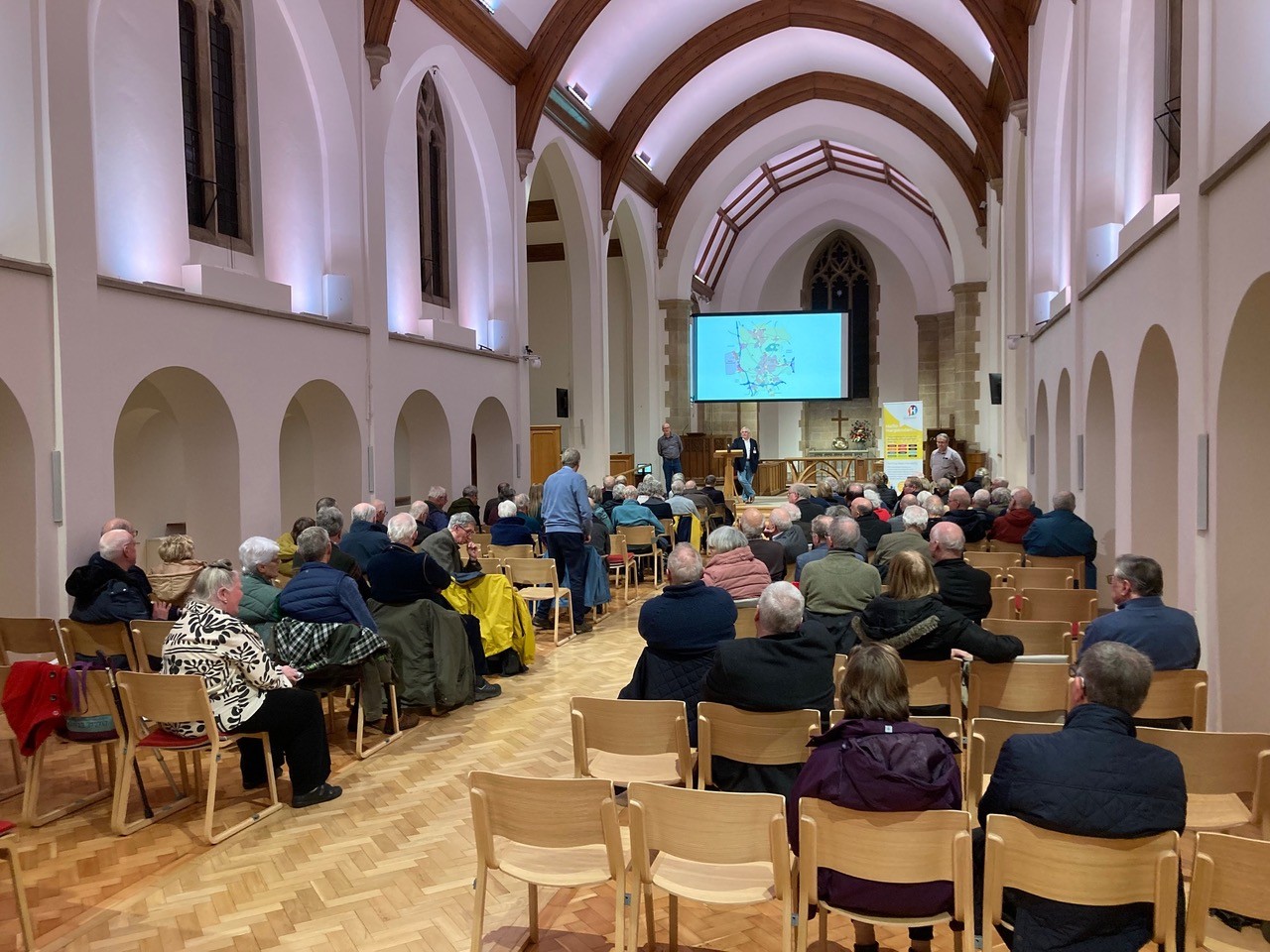
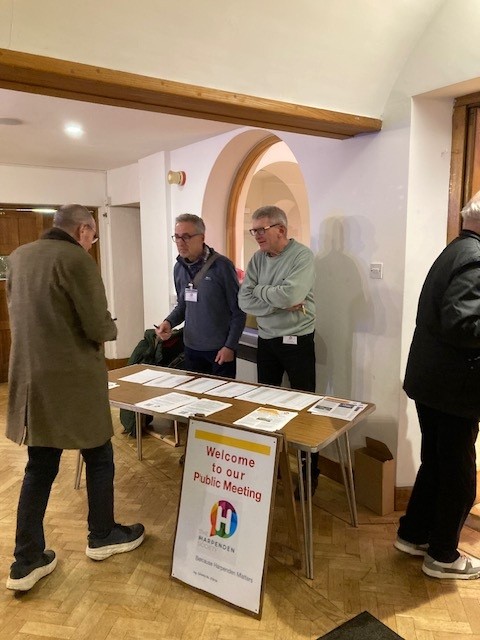
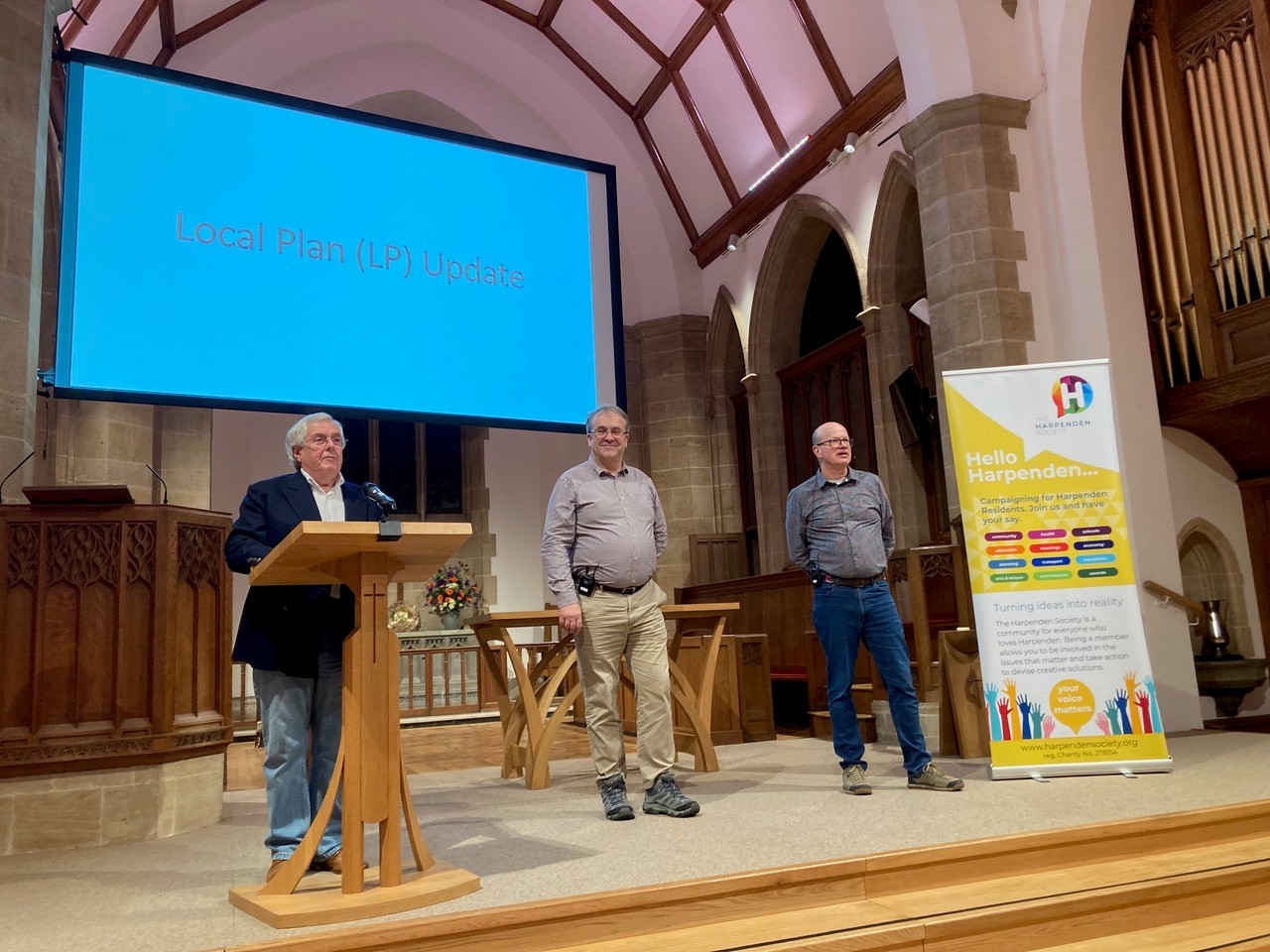
The Society Public Meeting on Jan 22 was held at the High Street Methodist Church which was attended by an audience of over 100 . Guest speakers Cllr Paul de Kort and HCC Paul Kukowskij gave an update on the Local Plan and implications of further government planning legislation.
Can the Local Plan adoption meet new housing challenges?
‘Viability’ has become a key issue among the many factors affecting the housing targets demanded in the St Albans District Local Plan, says SADC Council Leader Paul de Kort, in providing his third update to what is now a decades-old saga. Speaking to an audience of over a hundred Harpenden Society members and other residents at the Society’s January public meeting in High Street Methodist Church, he said the viability challenge was certain to arise when the council came to discuss with would-be developers the revised government target of 27,000 new homes required to be built in the district between the Local Plan’s now-imminent adoption and the year 2041 – an increase of 12,000, or 80%, more than the previous Conservative government’s target.
Supported by his fellow speaker at the meeting, Paul Zukowskyj, Herts County Council portfolio holder for Environment, Transport and Growth, Cllr de Kort pointed out the likely reluctance of developers to submit large scale housing proposals if their profitability was in doubt, notwithstanding the high property prices in this part of south-east England. It was, he indicated, a question made more acute by the requirement for at least 12.5% of the homes in any large development to be social housing and for another 27.5% homes to be notionally ‘affordable’ to private buyers.
Infrastructure funding
Then there was the all too often neglected matter of supporting infrastructure, notably highways, schools and medical services, and how the necessary funding would be apportioned between the developer and the local authority. To give an idea of the financial challenge, Cllr de Kort said it had been calculated that the now approved development of over 500 homes between Bloomfield Road and Cooters End lane in Harpenden would require groundwork infrastructure alone costing c.£400k, clearly without allowing for inevitable inflation.
The overall sum likely to be made available for infrastructure development needed to meet the proposed Local Plan was already accepted by both SADC and HCC as being nowhere near sufficient.
Cllr Zukowskyj then raised the related subject of deliverability. The construction industry nationwide had quite rightly questioned developers’ ability to actually build the number of homes demanded by government in the 15-year period covered by Local Plans. At the most fundamental level, would there be enough bricks or, perhaps more crucially, bricklayers to lay them?
‘Use it or lose it’ issue
Cllr De Kort added that without further legislation to force developers to actually complete construction, it was questionable as to whether the Local Plan could actually be delivered by 2041. The issue of developers sitting on their planning approved ‘land banks’ to maximise profitability (as is their current modus operandi) could only be changed if a ‘use it or lose it’ time period provision was introduced into the planning permission.
Another change in the planning system much publicised by the Government is the recent categorisation of some potential building land as ‘Grey Belt’,which has already been seen in some quarters as an unwelcome easing of existing Green Belt restrictions, Cllr de Kort said it was still ill defined but looked unlikely to affect the status or vulnerability of sites in the district already classed as either Green Belt or ‘brown site’ land.
However in determining suitable sites for new homes, he added, questions also remained over the matter of density, i.e. the maximum number of dwellings per hectare, as well as their visual compatibility with existing houses nearby or other buildings. Secretary of State for Housing Steve Reed had in any case indicated the government’s intention, in scrutinising development proposals, to prevent ‘coalescence’ of distinctive settlements outside the main conurbations. Locally that would mean, for example, maintaining green space between Harpenden and its Redbourn and Wheathampstead neighbours.
Future unitary authorities?
This was an issue which, he indicated, was bound to arise following the major local government reorganisation now planned, which would see Hertfordshire County Council replaced from 2028 by a number of ‘unitary authorities’, with the yet to be created St Albans City Council and Harpenden Town Council being ‘lumped in’ with one or more adjacent council areas. There were suggestions that, in such a reconfigured unitary authority containing St Albans and/or Harpenden, an overall ‘social development strategy’ would need to emerge. How this would happen remains unclear, as Government has yet to give any guidance.
This reorganisation could conceivably affect the whole structure of SADC’s Local Plan in the longer term, but it was hoped that the Local Plan as submitted would be finally adopted this coming June or early July.
Cllr de Kort cautioned however that the Plan’s adoption was, as ever, in the hands of government inspectors who, as we are only too well aware, had thrown up last minute obstacles on two previous occasions. However, the indications are that following the latest round of the Inspectors’ public examinations of the Plan, the issues they have raised have in overall terms been relatively minor.
But you never know until their final pronouncement.
He did assert however, in closing, that the Local Plan’s adoption could not be derailed by the results, in party political terms, of the local authority elections in May.